
Climatic Design Codes
for Mediterranean Cities
PIs: Prof. Dr. Tali Hatuka, Tel Aviv University
Hadas Saaroni
RA: Assaf Frances
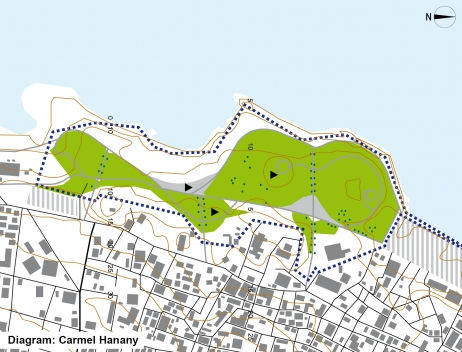
Over three decades, a warming trend, more extensive than the global rate, has been observed in the Mediterranean Basin (MB) during summer. Coastal regions experience high temperatures and humidity, creating Heat Stress (HS). Urban coastal cities become over-heated urban islands. Elevated temperatures increase air stability, trapping moisture and pollutants, worsening HS, energy use, urban heat island effect, and pollution. Rapid urban growth and social pressures impact the environment unevenly. Sustainable regeneration plans must include creating healthy, attractive communities. Urban design often overlooks climate considerations, ignoring human comfort. This project questions if climate should be central to urban planning, examining human comfort, sustainability complexities, and climate integration. It presents urban design codes and language for Mediterranean cities in Israel to face climate challenges.
For further reading:
Hatuka, T. & Saaroni, H. (2014). The need for advocating design codes in an era of climate change: A case study of a Mediterranean urban park, Landscape Research, 39(3), 287–304. https://doi.org/10.1080/01426397.2012.720249
Hatuka, T., & Saaroni, H. (2013). Resilience of outdoor spaces in an era of climate change: The Problem of developing countries, Sustainability, 5, 90–99. https://www.mdpi.com/2071-1050/5/1/90
Saaroni, H., Pearlmutter, D., & Hatuka, T. (2014). Microclimate and thermal perception in a Mediterranean coastal urban park, International Journal of Biometeorology, 59(10), 1347–1362 https://doi.org/10.1016/j.apgeog.2012.11.001
Support for this project was provided by LCUD, Tel Aviv University.